For the sake of simplicity (and most general applicability), we’ll use Delaware as the prevailing jurisdiction throughout this discussion.
When first learning of Public Benefit Corporations (“PBCs”), some of the most common questions we hear are:
- “Is that another name for a B Corp?”
- “Is that another form of incorporation, like a B Corp and a C Corp?”
- “I assume it’s different than a B Corp, but basically the same thing? Like for non-profits?”
The confusion stems partly from all of them having single letters and “corporation” in the name, and that a single company can be all three things at once (!).
- “C Corporation” is a tax classification: a corporation taxed under Subchapter C of the Internal Revenue Code.
- “Public Benefit Corporation” is a legal status: declared in a company’s charter, allowing directors to balance profit with a public benefit.
- “B Corporation” is a credential: it is provided to companies who engage with B Lab and meet certain standards.
Let’s clarify the difference by visualizing the relationship between a company’s legal foundation and the credentials applied to it.
Legal Foundations and Credentials
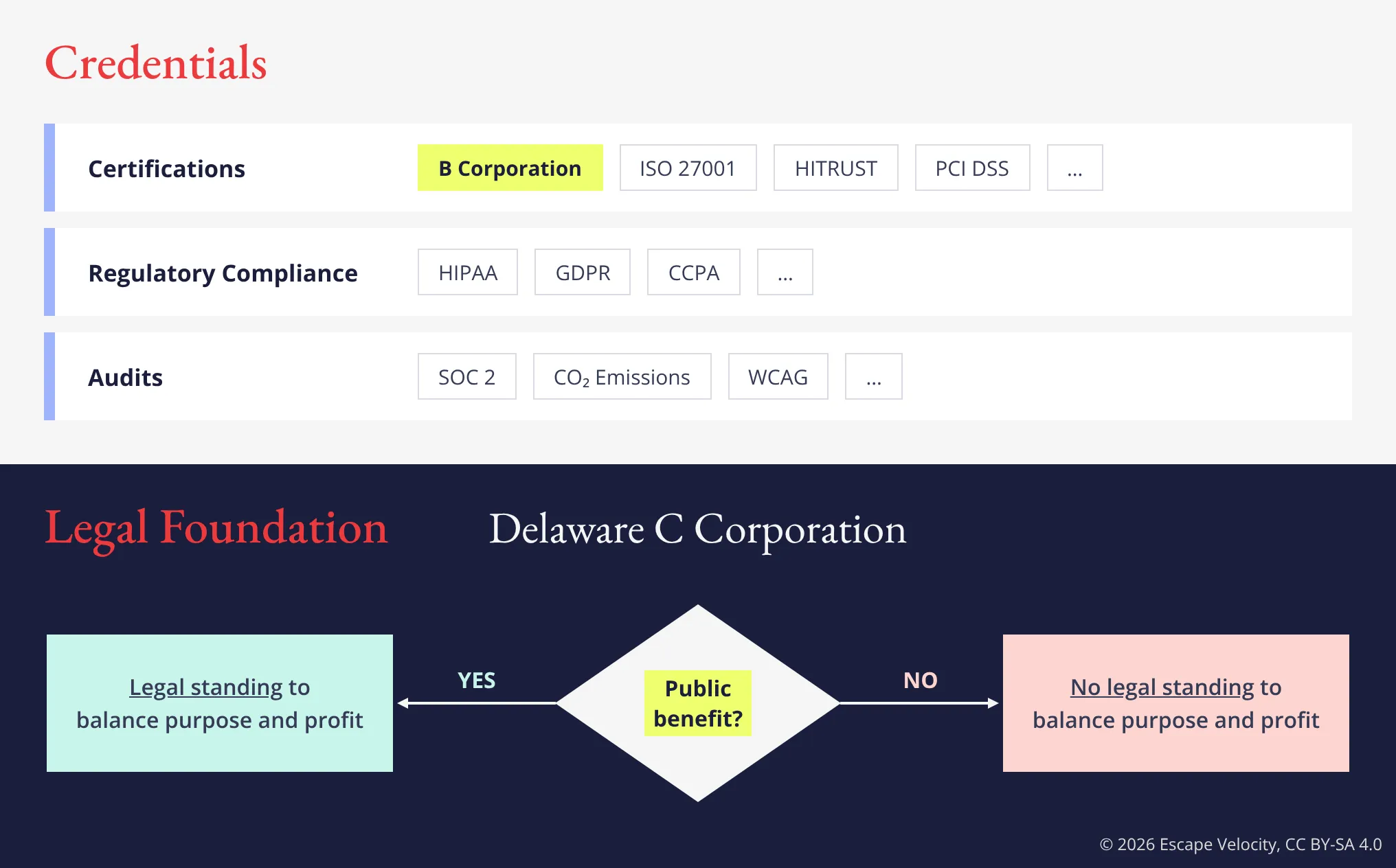
Your legal foundation is captured in your charter documents. For example, are you a C Corp or an S Corp? What majority is required to amend the company charter? Who can veto a transaction? Have you chosen to be a PBC?
Credentials exist outside your legal foundation. Some are optional and some are required by law depending on your industry and/or operational jurisdiction(s). For example, the US HHS defines which companies are required to comply with HIPAA privacy standards. Conversely, ISO 27001 and B Corp certifications are optional.
From their locations in the above, we can see that Public Benefit Corporation status is stated in your charter document as part of the legal framework of your company whereas B Corporation certification is obtained after-the-fact.
Why Be(come) A Public Benefit Corporation?
The Incorruptible blueprint is that we “create things worth protecting” and “build with integrity”. In this context, “integrity” refers to the corporate governance foundation that allows us to keep the promises we make to ourselves, our customers, employees, communities and shareholders.
In order for us to build with integrity, we must include an election to be considered a Public Benefit Corporation. This provides us the legal standing to prioritize purpose over profit.
If you’d like a hand sorting through all of this, talk to us!