
Vision, Purpose, Mission, Ethos, Doctrine

Question
In your recent Incorruptible training, you presented Vision, Purpose, Mission (+Ethos & Doctrine). Why is it necessary to introduce a new set of vocabulary to the already crowded space of Vision/Mission/Values (or V2MOM, OKRs, Theory of Change, and so on)? And where are the values in your framework? I use Vision, Mission, Values and tend to focus on helping companies rediscover their DNA [snip…]
Answer
Your orientation is spot-on and well aligned with the Incorruptible system: rediscovering your DNA, aligning strategy and execution, simplifying and breaking through fiefdoms. All yes! Vision/Mission/Values can be an effective framework if you’re working to protect & reinforce the purpose only from inside the company, at the operational level.
However, the Incorruptible system also works to protect against external pressures as well as internal, at the board and shareholder level. For those protections, you will want to convert from the standard Delaware C Corporation into a Delaware Public Benefit Corporation. This gives the board the legal right & obligation to step away from shareholder-above-all governance.
As a result, we’ve had to revisit Vision/Mission/Values and similar frameworks for one unavoidable and essential reason: In the Delaware PBC charter, the word “mission” is a legal term with a specific function.
Conventionally, mission statements are motivational tools to guide behavior and inspire stakeholders. They’re written by passionate visionaries to describe an aspiration and an intention. Unfortunately, the courts have rejected this style of mission statement, which (in their words) have “flowery language” and are ineffective as legal benchmarks.
Because of this, a PBC’s mission is instead written to create legally defensible guardrails.
To be effective, these mission statements need three characteristics that are more about creating a case for what’s legally in and out of bounds, based on what you wish to achieve. They can be rather more dry, and less optimized for inspiring and motivating employees and stakeholders. They must be:
Broad enough to enable a wide range of options for the business over the long term
Specific enough to exclude business that would violate the intended outcome
Written in such a way that the mission can be contradicted. You (and a court) can clearly identify what business decisions would be out-of-bounds
Nonetheless, we still need statements that clearly name what you’re here to do and why. So, with mission relegated to the legal frame, we chose the words Vision and Purpose to guide and inspire employees and stakeholders.
There’s a range of accepted usages for these words. Six Sigma describes Vision as “a concise, forward-looking statement that defines a company's long-term aspirations and purpose,” whereas Theory of Change describes Vision as “the desired future situation” and explicitly differentiates it from the organization’s impact statement.
We opted to lean toward the Impact community’s framework because it’s specific and practical: Vision is the macro change you’re participating in. Purpose is your part in that change.
In this way, you connect your work to something greater, and then name your own contribution. (A scheme that’s analogous to TAM, SAM, SOM, which identifies the greater market, and then your part within it.)
This structure of Vision + Purpose creates a focused and actionable understanding among stakeholders, and supports storytelling for internal communications and pitches. (“Here’s the macro trend (vision), here’s our part in it (purpose), and here’s the 3-year strategy for getting us there.”)
The value of this framework is in its interlocking specificity. The purpose is to preserve and promote human flourishing by having a mission and defending it from both internal drift and external threats. That begins with the legal PBC language and continues through to the day-to-day ways in which we treat each other. Bottom line – use any words that help you get the job done.
Note Regarding Ethos and Values
Values statements are incredibly useful for building a distinctive and durable culture. However, many combinations of values can be deployed to meet the same mission: a health care company can lead with Winning Spirit or with Respect. Values run alongside the work you’re doing to execute on mission and protect it, giving your organization a distinctive identity, sense of belonging, and collection of strengths.
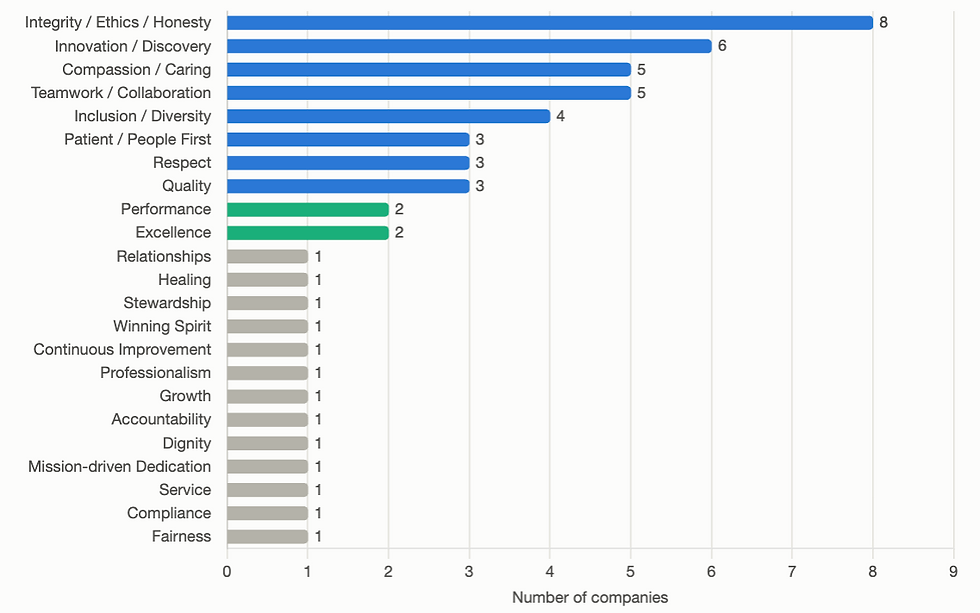
Ethos is a singular concept that captures that unique identity and shapes decisions at every level. It’s the cumulative outcome of experiences and decisions over time. In this way, it’s a lot like “brand”. You might say that ethos is where values and purpose intersect. It’s a single thought, and can be hard to see or define early on.